Got Questions?

Frequently Asked Questions

Find answers to the most common questions about IBC totes, our services, recycling programs, and pricing.

Get a Free Quote

Tell us what you need — we respond within 24 hours.

Use a valid US ZIP or Canadian postal code.

Use a real email address with a working inbox.

Enter a real US or Canadian phone number.

Optional, but helpful. Add at least 10 characters if you include a message.

Quick Answers

Yes-or-no answers to the questions we get asked the most.

Do you buy back used IBC totes?

Yes

Is delivery available in Baltimore?

Yes

Do you sell food-grade totes?

Yes

Can you recondition my existing totes?

Yes

Do you accept credit cards?

Yes

Are volume discounts available?

Yes

Do you ship outside Maryland?

Yes

Can IBC totes hold hazardous materials?

Yes, with proper certification

Do you offer same-day quotes?

Yes, before 2 PM

Is weekend pickup available?

Saturday only

Do you sell stainless steel IBCs?

Yes

Can I visit your facility?

Yes, by appointment
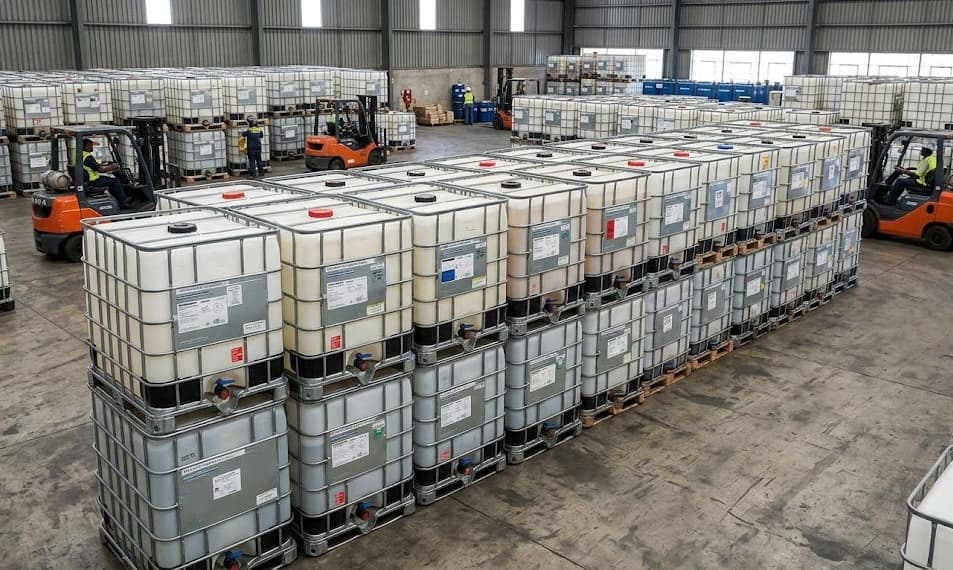
Aerial view of a warehouse filled with rows of IBC totes and forklifts

Got questions? We've got answers.

Browse our complete FAQ organized by topic below

All Questions by Category

Browse our complete FAQ organized by topic. Click any question to expand the detailed answer.

General

What is an IBC tote?+
An IBC (Intermediate Bulk Container) tote is a reusable industrial container used for storing and transporting bulk liquids, pastes, and granulated materials. Standard IBC totes consist of an HDPE (high-density polyethylene) inner bottle inside a galvanized steel cage, mounted on a pallet base. They range from 110 to 550 gallons and include a top fill opening and a bottom discharge valve for easy dispensing. IBCs have become the industry standard for bulk liquid transport because they offer a superior balance of capacity, portability, and reusability compared to drums and tank trucks.
What does IBC stand for?+
IBC stands for Intermediate Bulk Container. The term "intermediate" refers to the size range between small containers like drums (55 gallons) and large bulk tanks (thousands of gallons). IBCs bridge that gap, typically holding 275 to 330 gallons — enough volume for efficient bulk handling without requiring specialized tanker equipment. The term is recognized globally and standardized under UN packaging specifications, ensuring consistent sizing and safety standards across international supply chains.
Where is Baltimore IBC Recycling located?+
We are based in Baltimore, Maryland, and serve the entire Baltimore metropolitan area including Baltimore County, Anne Arundel County, Howard County, Harford County, and Cecil County. We also make regular pickups and deliveries throughout Maryland, Delaware, and the greater Mid-Atlantic region. Our facility is conveniently located near major interstates for easy access by truck and trailer. Contact us for delivery availability to your specific location or to schedule a visit to our yard.
What industries do you serve?+
We serve a wide range of industries including food and beverage manufacturing, chemical processing, pharmaceutical production, agriculture, water treatment, cosmetics, paints and coatings, automotive fluids, and general manufacturing. Our IBC totes are also popular with breweries, wineries, distilleries, soap makers, and cleaning product manufacturers. Whether you need a single tote for a small operation or hundreds for a large-scale production facility, we have the inventory and expertise to meet your needs.
How long has Baltimore IBC Recycling been in business?+
Baltimore IBC Recycling has been serving the Mid-Atlantic region for over 8 years. During that time, we have processed more than 80,000 IBC totes and built lasting relationships with over 500 commercial clients. Our team brings decades of combined experience in industrial container management, logistics, and environmental compliance. We have grown from a small local operation to one of the leading IBC recyclers in the region by consistently providing quality products, fair pricing, and reliable service.
Do you have a physical location I can visit?+
Yes, we welcome visitors at our Baltimore facility by appointment. You can tour our yard, inspect available inventory in person, and discuss your requirements with our team. We recommend calling ahead so we can prepare the specific tote types and sizes you are interested in seeing. Our facility is open Monday through Friday from 7:00 AM to 5:00 PM and Saturday from 8:00 AM to 1:00 PM. Drive-up access is available for customers with trucks and trailers.

Products

What sizes of IBC totes do you sell?+
We stock four standard IBC sizes: 110 gallon, 275 gallon, 330 gallon, and 550 gallon. The 275-gallon is our most popular and is the industry standard. All sizes are available in new, reconditioned, and used conditions. Visit our Size Guide for detailed dimensions, weights, and specifications for each size. We also occasionally have non-standard sizes and specialty containers available, so contact us if you need something outside the standard range.
What is the difference between new, reconditioned, and used totes?+
New totes come directly from the manufacturer with full warranty and certifications. Reconditioned totes have been professionally cleaned, inspected, and fitted with new gaskets, valves, and caps — they cost 40-60% less than new and are suitable for most industrial applications. Used (as-is) totes are sold in their current condition at the lowest price, ideal for non-critical applications like rainwater collection or waste storage. Each condition grade serves a specific purpose, and our team can advise you on the best choice for your intended use.
Do you sell food-grade IBC totes?+
Yes. We stock new food-grade HDPE totes that are FDA-compliant for direct contact with food products. We also offer reconditioned food-grade totes that have been rebottled (new inner bottle installed in an existing cage), which provides food-grade compliance at a lower cost. Always verify the FDA/food-grade certification label on the bottle before using for food contact. Food-grade totes are available in 275-gallon and 330-gallon sizes, and we can source 110-gallon food-grade units on request with a short lead time.
Can I get IBC totes in stainless steel?+
Yes, we carry both 304 and 316L stainless steel IBCs in 275-gallon and custom sizes. Stainless totes are ideal for pharmaceutical, food/beverage, and flammable chemical applications. They cost more than HDPE but last 20+ years and are fully recyclable. Stainless steel IBCs also resist corrosion from aggressive chemicals and can be steam-sterilized between uses. Contact us for current availability and pricing, as stainless steel inventory fluctuates based on market supply.
What types of valves are available on your IBC totes?+
Our totes come equipped with several valve options depending on the application. Standard butterfly valves are the most common and work well for water and thin liquids. Ball valves provide a tighter seal and better flow control for viscous materials and chemicals. We also offer camlock fittings, quick-connect adapters, and Banjo-style fittings for specialized connections. If your existing system requires a specific valve type, we can retrofit any tote before delivery at a nominal additional cost.
Do you carry IBC accessories and replacement parts?+
Yes, we maintain a full inventory of IBC accessories and replacement parts. This includes butterfly valves, ball valves, gaskets, dust caps, lid assemblies (both screw-top and vented), camlock adapters, sight gauges, heating blankets, insulation jackets, drip trays, and secondary containment pallets. We also stock forklift-compatible IBC mixers and agitators for blending applications. All parts are available for purchase individually or as part of a tote order.

Services

How does the IBC buyback program work?+
Our buyback program is simple: you contact us with the number of totes you want to sell, we inspect them (in person or via photos), and we offer a fair price based on condition, age, and current market value. We handle pickup and transportation at no additional cost for orders of 10+ totes within the Baltimore metro area. Payment is issued within 48 hours of pickup. Even damaged totes have value — we recycle the HDPE, steel, and wood components. Many businesses set up recurring monthly or quarterly buyback schedules with us.
Do you offer delivery?+
Yes. We deliver throughout the Baltimore metro area and the Mid-Atlantic region. Delivery is free for orders of 10+ totes within Baltimore City and County. For smaller orders or locations outside our standard delivery zone, a flat delivery fee applies — contact us for a quote. We can also arrange nationwide shipping via common carrier for larger orders. All deliveries are scheduled in advance and we provide a delivery window so you can have receiving personnel and unloading equipment ready.
Can you clean and recondition my existing totes?+
Absolutely. Our reconditioning service includes pressure washing, interior sanitization, gasket and valve replacement, cage inspection and straightening, and relabeling. We can pick up your totes, recondition them at our facility, and return them — or you can drop them off. Turnaround is typically 3-5 business days for standard orders. For large fleet reconditioning (50+ totes), we offer expedited scheduling and can process up to 30 totes per day to minimize your downtime.
Do you offer custom IBC modifications?+
Yes. Common modifications include installing different valve types (butterfly to ball valve conversion), adding sight gauges, mounting level indicators, heating jackets or blanket installations, custom labeling, and fitting camlock or quick-connect adapters. We can also add secondary containment features, install mixing equipment, and apply custom paint or color coding for inventory management. Contact our team to discuss your specific requirements — most modifications can be completed within 2-3 business days.
Can you handle emergency or rush orders?+
Yes, we understand that production schedules do not always allow for standard lead times. We offer rush processing and delivery for an additional fee. In most cases, we can fulfill rush orders within 24-48 hours for in-stock items within our standard delivery area. For reconditioning rush orders, we can prioritize your totes and reduce turnaround to 1-2 business days. Call us directly for rush availability — our phone lines are staffed Monday through Saturday.
Do you offer fleet management services?+
Yes. For businesses that use IBCs regularly, we offer comprehensive fleet management programs. This includes scheduled delivery of clean totes, pickup of empties, reconditioning on a fixed rotation, asset tracking, and detailed reporting on your fleet status. Fleet management eliminates the hassle of managing IBC inventory and ensures you always have clean, certified totes ready when you need them. We tailor each fleet management agreement to the client's volume, schedule, and budget.

Recycling & Sustainability

What happens to IBC totes that are recycled?+
When an IBC tote reaches the end of its useful life, we disassemble it into three recyclable streams: the HDPE bottle is shredded and pelletized for use in manufacturing new plastic products (pipes, lumber, containers); the steel cage is sent to a metal recycler and melted down for new steel; and wooden pallets are chipped for mulch or biomass fuel. Over 98% of the tote by weight is diverted from landfill. This closed-loop approach ensures that virtually no material from an IBC tote is wasted.
Is recycling IBC totes better for the environment than buying new?+
Significantly. Reconditioning and reusing an IBC tote saves approximately 75% of the carbon emissions compared to manufacturing a new one. Each reconditioned tote keeps roughly 130 lbs of plastic, steel, and wood out of the waste stream. Even when a tote is fully recycled (shredded), the material recovery is far better than landfill disposal. Our sustainability report has detailed metrics on environmental impact, and we provide certificates documenting the specific savings for each batch of totes we process.
Can IBC totes be recycled if they held hazardous materials?+
Yes, but they require special handling. IBC totes that contained hazardous materials must be triple-rinsed or decontaminated according to EPA and DOT guidelines before recycling. We accept hazmat totes and handle the decontamination process in compliance with all applicable regulations. Additional fees may apply depending on the previous contents. Always provide the Safety Data Sheet (SDS) when selling or recycling hazmat-exposed totes so we can determine the appropriate cleaning protocol and disposal method for rinse water.
How does IBC recycling compare to landfill disposal in terms of carbon savings?+
Recycling one standard 275-gallon IBC tote saves approximately 68 kg of CO2 equivalent emissions compared to landfill disposal. This factors in the avoided extraction of virgin materials, reduced manufacturing energy, and the prevention of methane generation from decomposing materials in landfills. Over a fleet of 100 totes per year, recycling instead of landfilling saves roughly 6.8 metric tons of CO2 — equivalent to taking 1.5 cars off the road for a year. These savings compound significantly for larger operations.
Do you provide documentation for sustainability reporting?+
Yes. We provide detailed recycling certificates and environmental impact summaries for all totes processed through our facility. These documents include material weights by stream (HDPE, steel, wood), landfill diversion percentages, and estimated carbon savings. Many of our corporate clients use these certificates for their annual ESG (Environmental, Social, Governance) reports and sustainability compliance documentation. We can also provide customized reports formatted to match your organization's specific reporting requirements.
What is your zero-waste-to-landfill goal?+
Our goal is to achieve 100% diversion from landfill for all IBC materials we process. Currently, we achieve a 98% diversion rate. The remaining 2% consists of non-recyclable labels, adhesive residues, and contaminated rinse filters. We are actively working with our recycling partners to find solutions for these remaining waste streams. By 2027, we aim to close the gap entirely through improved decontamination processes and partnerships with specialty recyclers that can handle these difficult-to-recycle materials.

Pricing & Orders

How much does a used IBC tote cost?+
Prices vary by size, condition, and quantity. As a general guide for 275-gallon HDPE totes in the Baltimore area: used (as-is) totes range from $50-$120, reconditioned totes from $100-$200, and new totes from $250-$450. Volume discounts of 10-25% are available for orders of 10+ totes. Contact us for a current quote — prices fluctuate with supply and demand. Stainless steel and specialty totes are priced separately based on availability and specifications.
Do you offer volume discounts?+
Yes. We offer tiered pricing for bulk orders: 10-24 totes receive approximately 10% off, 25-49 totes receive 15% off, and orders of 50+ totes receive up to 25% off list pricing. Large recurring orders qualify for additional contract pricing. Free delivery is included for all orders of 10+ totes within the Baltimore metro area. We also offer annual contract pricing for businesses that purchase on a regular schedule, which locks in your rate regardless of market fluctuations.
What payment methods do you accept?+
We accept cash, check, ACH bank transfer, credit cards (Visa, Mastercard, American Express), and net-30 terms for established commercial accounts. For buyback payments, we issue checks or ACH transfers within 48 hours of tote pickup and inspection. New commercial customers can apply for net-30 terms after their first paid order, and we also offer net-15 terms for businesses that prefer a shorter billing cycle. All invoices include itemized details for easy bookkeeping.
How quickly can I get a price quote?+
We respond to quote requests within 24 hours on business days, and aim for same-day responses for inquiries received before 2:00 PM. For standard stock items (used and reconditioned 275-gallon totes), we can often provide a quote over the phone immediately. Complex orders involving custom specifications, large quantities, or specialty sizes may take up to 48 hours for a detailed quote. We can also set up standing price agreements for repeat customers so you always know your cost upfront.
Do prices include delivery?+
Delivery is free for orders of 10 or more totes within Baltimore City and Baltimore County. For smaller orders or locations outside our standard delivery zone, a flat delivery fee applies — typically $50-$150 depending on distance and quantity. We can also arrange nationwide shipping via common carrier for larger orders. The delivery fee is always disclosed upfront in your quote so there are no surprises. Ask about our bundled pricing options that include delivery for smaller orders at a reduced total cost.

Shipping & Logistics

What is your delivery area?+
Our primary delivery area covers the entire Baltimore metropolitan area including Baltimore City, Baltimore County, Anne Arundel County, Howard County, Harford County, Cecil County, and Carroll County. We also make regular deliveries to Washington D.C., Northern Virginia, Delaware, and southern Pennsylvania. For locations outside our standard area, we can arrange shipping via common carrier to anywhere in the continental United States. Contact us to confirm delivery availability and pricing for your specific location.
How long does delivery take after I place an order?+
For in-stock items within our standard delivery area, delivery is typically scheduled within 3-5 business days of order confirmation and payment. Rush delivery within 24-48 hours is available for an additional fee. Large orders (50+ totes) may require staggered delivery depending on your receiving capacity. We coordinate delivery timing with you to ensure someone is available to receive the shipment. You will receive a confirmation call or email the day before your scheduled delivery with an estimated arrival window.
What equipment do I need to unload IBC totes?+
You will need a forklift with at least a 5,000 lb capacity and forks that are at least 42 inches long (48 inches preferred for 275-gallon totes). A standard pallet jack can handle empty totes but is not practical for full ones, which weigh over 2,400 lbs. Our delivery trucks carry a liftgate for ground-level delivery when forklift access is not available, but you will still need equipment to move totes from the delivery point to your storage area. Let us know about your unloading capabilities when you place your order so we can plan accordingly.
Can I pick up totes at your facility instead of having them delivered?+
Absolutely. Customer pickup is available Monday through Friday from 7:00 AM to 5:00 PM and Saturday from 8:00 AM to 1:00 PM. Please call ahead to confirm your order is ready for pickup. You will need an appropriate vehicle — a standard pickup truck can carry one empty tote, a flatbed can carry 4-6, and a full-size trailer can hold up to 80. We load with our forklift at no charge. We also have a covered loading area so pickups can proceed in most weather conditions.
How are IBC totes shipped for long-distance orders?+
For orders shipping outside our local delivery area, we use LTL (Less Than Truckload) and FTL (Full Truckload) common carriers. Empty IBCs can be nested or stacked to reduce shipping costs — up to 4 empty totes can fit in the space of one on a standard trailer. We handle all freight coordination, including carrier selection, BOL (Bill of Lading) preparation, and delivery scheduling. Freight costs are quoted separately based on destination, quantity, and whether totes are empty or full. We pass through carrier rates at cost with no markup.
Do you offer scheduled recurring deliveries?+
Yes. Many of our commercial clients set up recurring delivery schedules — weekly, biweekly, or monthly — to ensure they always have a fresh supply of clean totes on hand. Recurring delivery customers receive priority scheduling, guaranteed availability for their specified tote type and quantity, and often qualify for additional pricing discounts. We can also combine delivery of clean totes with pickup of empties on the same trip, which reduces your logistics burden and transportation costs.
What happens if a tote is damaged during delivery?+
We take full responsibility for any damage that occurs during transit on our own delivery trucks. If a tote arrives damaged, we will replace it at no charge on the next available delivery. For shipments via third-party carriers, all totes are inspected and photographed before loading. If damage occurs in transit, we assist you with filing a freight claim and will expedite a replacement shipment. We recommend inspecting all totes at the time of delivery and noting any visible damage on the delivery receipt before signing.

Regulatory & Compliance

What UN/DOT certifications apply to IBC totes?+
IBC totes used for transporting hazardous materials must carry a valid UN marking, typically 'UN 31HA1' for composite IBCs (HDPE bottle in a steel cage). The marking includes the manufacturer code, date of manufacture, maximum gross mass, maximum specific gravity of contents, and hydrostatic test pressure. DOT requires that IBCs used for hazmat transport be inspected and recertified every 2.5 years and fully requalified or replaced every 5 years from the date of manufacture. Non-hazmat applications do not require UN certification, but using certified totes is still a best practice.
What are the EPA regulations for recycling IBC totes that held chemicals?+
The EPA requires that containers which held hazardous substances be triple-rinsed with an appropriate solvent before recycling or disposal. The rinse water itself must be managed as hazardous waste if it contains listed or characteristic hazardous constituents. Under RCRA (Resource Conservation and Recovery Act), a container is considered "empty" once it has been triple-rinsed or cleaned by a method shown to achieve equivalent removal. Our facility maintains all required EPA permits and follows documented procedures to ensure full regulatory compliance for every tote we process.
Are there FDA requirements for food-grade IBC totes?+
Yes. IBC totes used for direct food contact must be manufactured from FDA-approved materials, primarily virgin HDPE that meets 21 CFR 177.1520 standards. The manufacturing facility must follow Good Manufacturing Practices (GMP), and each tote must be traceable to its production lot. For reconditioned food-grade totes, the replacement bottle must be new, FDA-compliant, and the tote must have a documented chain of custody showing it was not previously used with non-food products. We maintain all FDA documentation and can provide certificates of compliance upon request.
What are the OSHA requirements for storing IBC totes?+
OSHA requires that IBC totes be stored on level, stable surfaces capable of supporting the full weight of the loaded container. Stacking is permitted only if the totes are rated for stacking (check the UN marking for stacking load rating) and do not exceed two units high when full. Adequate aisle space must be maintained for forklift access and emergency egress. If totes contain flammable or combustible liquids, they must be stored in accordance with NFPA 30 (Flammable and Combustible Liquids Code), which includes requirements for ventilation, fire suppression, and secondary containment. We can advise on proper storage configurations as part of our customer support.
Do I need a permit to store IBC totes on my property?+
Permitting requirements vary by jurisdiction and depend on what the totes contain. Storing empty or water-filled IBC totes generally does not require a special permit. However, storing totes containing hazardous chemicals, flammable liquids, or waste materials may require environmental permits, fire department approval, or zoning clearance. In Baltimore City and Baltimore County, businesses storing more than a certain threshold of hazardous materials must file a Tier II report with the local fire department and the Maryland Department of the Environment. We recommend consulting your local code enforcement office for specific requirements in your area.

Technical Specifications

What is the difference between a butterfly valve and a ball valve?+
A butterfly valve uses a rotating disc inside the valve body to control flow. It is the most common valve on HDPE totes and is ideal for water and thin liquids. A ball valve uses a spherical plug with a hole through the center, providing a tighter seal and better control for viscous liquids, chemicals, and hazmat applications. Ball valves cost more ($25-45 vs $15-25) but offer superior leak resistance and are preferred for high-value or sensitive products. We can retrofit either valve type onto any standard IBC tote before delivery.
How do I know if my IBC tote is UN/DOT certified?+
Check the data plate on the steel cage — it should show a UN marking such as 'UN 31HA1' followed by a series of numbers and letters indicating the manufacturer, date of manufacture, maximum specific gravity, and test results. The marking is typically stamped or printed on a metal plate welded to the cage frame. If the data plate is missing or illegible, the tote cannot be verified as UN-certified and should not be used for regulated hazardous material transport. Our team can help you read and interpret UN markings if you send us a photo of the data plate.
What is specific gravity (SG) and why does it matter?+
Specific gravity is the ratio of a liquid's density to the density of water. Water has an SG of 1.0. A liquid with an SG of 1.5 is 50% heavier than water. Every UN-rated IBC tote has a maximum SG rating stamped on its data plate — typically 1.0, 1.2, 1.5, or 1.9. You must ensure that your product's SG does not exceed the tote's rating, because a heavier liquid puts more stress on the bottle, cage, and pallet. Exceeding the SG rating voids the UN certification and creates a safety risk during transport and stacking.
Can I use an IBC tote for drinking water storage?+
Only if the tote has a food-grade certified HDPE bottle that has never been used for non-food products. New food-grade totes are FDA-compliant and safe for potable water contact. Used or reconditioned totes should not be used for drinking water unless they have been rebottled with a new food-grade inner bottle and you can verify the complete history of the tote. Even food-grade totes should be cleaned and sanitized before first use for drinking water. For long-term water storage, we recommend opaque covers to prevent algae growth from UV exposure.
How long does an HDPE IBC bottle last?+
Under ideal conditions (indoor storage, compatible products, regular maintenance), an HDPE bottle can last 5-7 years. For UN/DOT regulated transport of hazardous materials, the DOT limits use to 5 years from the date of manufacture, after which the tote must be rebottled or removed from hazmat service. UV exposure, aggressive chemicals, and extreme temperatures all shorten the useful life. Many non-regulated applications (water storage, non-hazardous chemicals) continue to use HDPE bottles safely well beyond 5 years with proper care and inspection.
What is rebottling and when is it worth doing?+
Rebottling is the process of removing the old HDPE inner bottle from an IBC cage and installing a brand-new bottle. The result is essentially a new container at 50-70% of the cost of buying a completely new IBC. Rebottling makes economic sense when the cage and pallet are still in good condition but the bottle has UV damage, odor absorption, cracks, or has exceeded its DOT certification period. The new bottle comes with a fresh manufacture date and can be food-grade certified. Most rebottling jobs are completed within 1-2 business days at our facility.
What is the maximum stacking height for IBC totes?+
The maximum stacking height depends on the tote's UN rating and whether the totes are full or empty. Most standard 275-gallon composite IBCs are rated for stacking two high when fully loaded (check the data plate for the specific stacking test load). Empty totes can typically be stacked three to four high safely. Never exceed the manufacturer's stacking recommendation, as overloading can cause cage buckling, bottle distortion, and catastrophic failure. For long-term storage, we recommend using stacking frames or racking systems to protect the lower totes from excessive load.
What temperatures can HDPE IBC totes withstand?+
Standard HDPE IBC bottles are rated for continuous use between -40 degrees F and 140 degrees F (-40 degrees C to 60 degrees C). Filling temperatures should not exceed 158 degrees F (70 degrees C) for brief periods. Temperatures above this threshold can cause permanent deformation of the bottle and compromise the structural integrity of the cage fit. For applications requiring higher temperature resistance, stainless steel IBCs can handle continuous temperatures up to 300 degrees F (150 degrees C). If you need to store temperature-sensitive products, we offer insulated jackets and heating blankets as accessories.

Warranty & Returns

What warranty do you offer on reconditioned IBC totes?+
All reconditioned IBC totes from Baltimore IBC Recycling come with a 90-day warranty covering defects in workmanship related to our reconditioning process. This includes valve leaks, gasket failures, and cage integrity issues that result from our reconditioning work. The warranty does not cover damage from misuse, overloading, chemical incompatibility, or normal wear and tear. If you experience a warranty issue, contact us with photos and a description of the problem, and we will arrange a replacement or repair at no charge. New totes carry the manufacturer's standard warranty, which is typically one year.
Can I return IBC totes if they do not meet my needs?+
Yes, we accept returns within 14 days of delivery for totes that are in the same condition as when they were delivered. A restocking fee of 15% applies to returned totes. Custom-modified totes and special orders are non-returnable unless there is a defect in workmanship. To initiate a return, contact our team with your order number and the reason for the return. We will arrange pickup at a mutually convenient time. Refunds are processed within 5 business days of receiving the returned totes and confirming their condition.
What if I receive a tote that does not match the description?+
If a tote you receive does not match the condition, size, or specifications described in your order confirmation, contact us immediately. We will arrange a free exchange and cover all transportation costs for the replacement. We take product accuracy very seriously and inspect every tote before it leaves our facility. In the rare event that an error occurs, we prioritize making it right as quickly as possible — usually within 1-2 business days. We also welcome feedback on our product descriptions so we can continuously improve accuracy.
Do you offer extended warranty options?+
Yes, we offer an extended warranty program for businesses that purchase in volume. Our Extended Care plan extends the standard 90-day warranty to 12 months and includes one free reconditioning service during the warranty period. This plan is available for orders of 20 or more reconditioned totes at a cost of $15 per tote. The Extended Care plan provides peace of mind for businesses using IBC totes in demanding applications and ensures that any issues are resolved quickly without additional cost. Ask your sales representative for details when placing your order.

Custom Orders

Can you source specialty or hard-to-find IBC configurations?+
Yes. Our network of suppliers and partner recyclers across the East Coast allows us to source specialty IBCs that may not be in our standard inventory. This includes stainless steel totes with specific alloy grades, HDPE totes with anti-static additives, explosion-proof configurations, UN-rated totes for Packing Groups I and II, and large-format 550-gallon units. Lead time for specialty sourcing is typically 2-4 weeks depending on the configuration. Provide us with your specifications and we will quote availability and pricing within 48 hours.
Can you apply custom labels or branding to IBC totes?+
Yes. We offer custom labeling services including vinyl decals, direct printing, and stenciling on both the bottle and the cage. Common requests include company logos, product names, hazard diamonds, GHS labels, barcodes, and QR codes for inventory tracking. We can also apply color-coded cage bands for visual identification of product lines. Minimum order for custom labeling is typically 10 totes. Provide us with your artwork files and label specifications, and we will produce a proof for your approval before proceeding with production.
What is the lead time for custom-modified IBC totes?+
Lead time depends on the complexity of the modifications and current demand. Simple modifications like valve swaps, gasket upgrades, and label application are typically completed within 2-3 business days. More complex modifications such as sight gauge installation, heating jacket fitting, or custom plumbing assemblies may require 5-7 business days. For orders involving specialty sourcing combined with modifications, allow 3-5 weeks total lead time. We provide a detailed timeline with every custom order quote so you can plan accordingly.
Do you offer prototype or sample totes for testing?+
Yes. For new customers or new product applications, we can provide a single sample tote at standard pricing so you can verify compatibility with your product, evaluate fit in your production line, and test filling and dispensing operations before committing to a larger order. If you proceed with a bulk order within 30 days of receiving the sample, we credit the cost of the sample tote toward your order. This risk-free approach ensures you get exactly the right tote for your application without committing to a large upfront purchase.

Account & Billing

How do I set up a commercial account?+
Setting up a commercial account with Baltimore IBC Recycling is straightforward. Contact us by phone, email, or through our website contact form and request a commercial account application. We will ask for basic business information including company name, address, primary contact, tax ID, and expected order volume. Once approved — typically within 1-2 business days — you will receive a dedicated account number, access to net-30 payment terms, and a designated account representative who will handle all your orders and inquiries. There is no minimum purchase requirement to open an account.
What are your net-30 payment terms?+
Net-30 terms mean that payment is due within 30 days of the invoice date. This option is available to approved commercial accounts with a completed credit application on file. We review credit applications within 1-2 business days and may request trade references or a personal guarantee for new businesses. Net-30 accounts receive monthly statements and can pay via check or ACH transfer. Late payments are subject to a 1.5% monthly service charge. We also offer net-15 terms and prepaid discounts for businesses that prefer different billing arrangements.
Can I track my orders and invoices online?+
Currently, order tracking and invoice history are managed through your dedicated account representative. When you place an order, you receive a confirmation email with your order number, expected delivery date, and itemized pricing. For delivery tracking, we provide updates by phone or email as your order moves through processing and dispatch. We are actively developing an online customer portal that will allow real-time order tracking, invoice viewing, payment processing, and order history — expected to launch later this year.
How do I dispute a charge or request a billing adjustment?+
If you believe there is an error on your invoice or need a billing adjustment, contact your account representative or our billing department within 30 days of the invoice date. Provide your invoice number, the specific line item in question, and a brief description of the issue. We investigate all billing disputes within 2 business days and issue credits or corrected invoices as appropriate. Common adjustments include quantity corrections, pricing discrepancies, and delivery fee modifications. We aim to resolve all billing issues promptly and fairly to maintain your trust.
Do you offer financing for large orders?+
For very large orders (100+ totes or orders exceeding $10,000), we can arrange installment payment plans on a case-by-case basis. Typical arrangements include a 50% deposit at order placement with the balance due in two equal monthly payments. We do not charge interest on short-term payment plans of 60 days or less. For recurring large orders, we can also structure annual contracts with monthly billing to spread costs evenly across the year. Discuss your needs with your account representative to explore the best payment structure for your budget.

Still Have Questions?

Our team is happy to answer any questions not covered here. Reach out by phone, email, or through our contact form — we typically respond within a few hours during business days.

Call Us

Mon-Fri 7AM-5PM, Sat 8AM-1PM

(443) 555-0199

Email Us

Response within 24 hours

info@baltimoreibcrecycling.com

Contact Form

Submit your question online

Go to Contact Page