IBC Totes vs Drums
Which container is right for your application? We break down IBC totes, steel drums, and poly drums across every metric that matters.
Get a Free Quote
Tell us what you need — we respond within 24 hours.
Three Containers, Three Use Cases
When it comes to storing and transporting bulk liquids, businesses typically choose between three container types: IBC totes (275-330 gallon), steel drums (55 gallon), and poly drums (55 gallon). Each has distinct advantages depending on your volume, product type, storage space, and budget.
This guide provides a thorough, side-by-side comparison so you can make an informed decision. If you are currently using drums and considering switching to IBCs — or vice versa — the data below will help you calculate the true cost and operational impact.
At a Glance
IBC Tote
275 gallon (standard)
- Capacity: 275 gallons (1,040 liters)
- Footprint: 48" x 40"
- Weight (empty): 130 lbs
- Material: HDPE bottle + steel cage
- Fill method: Top opening + bottom valve
- Stackable: Yes (2 high when full)
- Forklift compatible: Yes (built-in pallet)
Steel Drum
55 gallon (standard)
- Capacity: 55 gallons (208 liters)
- Footprint: 23.5" diameter
- Weight (empty): 35-45 lbs
- Material: Carbon steel (lined or unlined)
- Fill method: Top bung openings
- Stackable: Yes (3-4 high with pallets)
- Forklift compatible: Requires pallet or drum handler
Poly Drum
55 gallon (standard)
- Capacity: 55 gallons (208 liters)
- Footprint: 23" diameter
- Weight (empty): 18-24 lbs
- Material: HDPE (open-head or closed-head)
- Fill method: Bung openings or removable lid
- Stackable: Yes (3-4 high with pallets)
- Forklift compatible: Requires pallet or drum handler
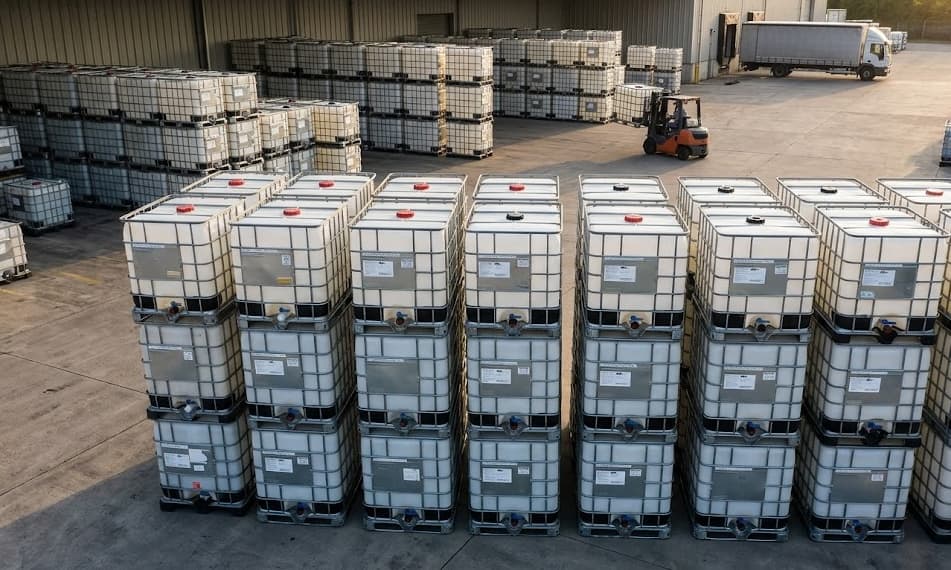
See why businesses are switching from drums to IBCs
Data-driven comparisons across every metric that matters
Detailed Comparison
| Metric | IBC Tote (275 gal) | Steel Drum (55 gal) | Poly Drum (55 gal) |
|---|---|---|---|
| Capacity | 275 gal (1,040 L) | 55 gal (208 L) | 55 gal (208 L) |
| Price (new) | $250 - $450 | $50 - $85 | $30 - $60 |
| Cost per gallon (container) | $0.91 - $1.64 | $0.91 - $1.55 | $0.55 - $1.09 |
| Equivalent drums per IBC | 1 IBC | 5 drums | 5 drums |
| Cost for 275 gallons | $250 - $450 | $250 - $425 (5 drums) | $150 - $300 (5 drums) |
| Floor space for 275 gal | 13.3 sq ft (1 unit) | 15.1 sq ft (5 drums) | 14.5 sq ft (5 drums) |
| Dispensing ease | Excellent (gravity valve) | Moderate (pump required) | Moderate (pump required) |
| Filling speed | Fast (6-8" opening) | Slow (2" bung) | Moderate (2" bung or open head) |
| Cleaning difficulty | Easy (wide opening) | Hard (narrow opening) | Moderate |
| Reuse cycles | 5-10+ (with reconditioning) | 3-5 | 2-4 |
| Service life | 5-10 years | 10-15 years | 3-7 years |
| Chemical resistance | Excellent (HDPE) | Good (lined) / Limited (unlined) | Excellent (HDPE) |
| UN/DOT certified | Yes | Yes | Yes |
Pros & Cons
IBC Tote
Advantages
- 5x the capacity of a drum in similar floor space
- Built-in pallet base — no separate pallet needed
- Gravity-fed bottom valve for easy dispensing
- Wide top opening makes filling and cleaning simple
- Highly recyclable — HDPE, steel, and wood all recovered
- Lower cost per gallon of storage capacity
- Fewer connections and transfer points (less spillage)
- Stackable up to 2 high when full
Disadvantages
- Higher upfront cost per unit
- Larger footprint than a single drum
- Requires forklift or pallet jack to move when full
- Not practical for small-volume applications under 50 gallons
- HDPE bottle degrades with UV exposure
Steel Drum
Advantages
- Extremely durable — resistant to impact and puncture
- Fire-resistant (critical for flammable storage)
- Long service life (10-15 years with lined interior)
- Can be manually rolled or tilted by a single person
- Widely available and universally recognized
- Good for high-viscosity products
Disadvantages
- Small capacity (55 gal) — need 5 for equivalent of 1 IBC
- Narrow bung openings make filling and cleaning difficult
- Requires drum pump for dispensing
- Heavier than poly drums (35-45 lbs empty)
- Susceptible to rust and corrosion (especially unlined)
- More handling labor per gallon transferred
- Requires separate pallets for forklift handling
Poly Drum
Advantages
- Lightest option — 18-24 lbs empty
- Excellent chemical resistance (HDPE)
- No rust or corrosion
- Lowest unit cost ($30-60 new)
- Open-head option available for solids and thick liquids
- Food-grade options widely available
Disadvantages
- Same 55-gallon capacity limitation as steel drums
- Not fire-resistant — melts under heat
- Shorter service life than steel or IBC
- UV degradation when stored outdoors
- Less impact-resistant than steel
- Requires drum pump for dispensing
- Separate pallets needed for forklift handling
Storage Efficiency: Warehouse Space Comparison
To store 2,750 gallons of product (equivalent to 10 IBC totes or 50 steel drums), here is how much warehouse space you need:
133
sq ft
10 IBC Totes
(single layer, not stacked)
151
sq ft
50 Steel Drums
(on pallets, single layer)
145
sq ft
50 Poly Drums
(on pallets, single layer)
Key insight: While floor space is similar, the real advantage of IBCs is handling efficiency. Moving 2,750 gallons with IBCs requires 10 forklift operations. With drums, it requires at least 13 pallet loads (4 drums per pallet) plus individual drum handling. For high-volume operations, IBCs can reduce labor costs by 40-60% compared to drums.
Environmental Impact Comparison
| Environmental Metric | IBC Tote | Steel Drum | Poly Drum |
|---|---|---|---|
| Material per 275 gal stored | ~130 lbs | ~200 lbs (5 drums) | ~110 lbs (5 drums) |
| Reuse cycles before end-of-life | 5-10+ | 3-5 | 2-4 |
| Recyclability rate | 98%+ | 95%+ | 70-85% |
| Carbon footprint (manufacture) | ~85 kg CO2e | ~135 kg CO2e (5 drums) | ~60 kg CO2e (5 drums) |
| Shipping weight per gallon | 0.47 lbs/gal | 0.73 lbs/gal | 0.40 lbs/gal |
| Reconditioning ease | Easy (rebottling available) | Moderate (relining needed) | Difficult (usually not reconditioned) |
From a lifecycle perspective, IBC totes offer the best balance of reusability, recyclability, and per-gallon efficiency. Steel drums have excellent recyclability (steel is infinitely recyclable) but use more material per gallon stored. Poly drums have the lowest per-unit carbon footprint but are the hardest to recondition and have the lowest recyclability rate among the three options.
When to Use Which Container
Choose an IBC Tote When:
- You need to store or transport more than 100 gallons of liquid
- You want gravity-fed dispensing without a pump
- You fill and dispense from the same container frequently
- Warehouse space efficiency is important
- You want to minimize handling labor and forklift operations
- You are shipping full truckloads and want to maximize payload per pallet position
- Sustainability and reusability are priorities for your organization
Choose a Steel Drum When:
- You need small batches (55 gallons or less)
- You store flammable liquids and need a fire-resistant container
- The container must withstand rough handling (construction, mining, field operations)
- You distribute products to multiple end users in 55-gallon quantities
- Regulations require steel containers for your specific product
- Manual handling by one or two people (rolling, hand trucks) is required
Choose a Poly Drum When:
- You need chemical resistance at the lowest cost
- Weight is a critical concern (mobile applications, manual handling)
- You need open-head access for solids, pastes, or thick liquids
- The product is corrosive to steel (strong acids, bleach, salt solutions)
- You are distributing food-grade products in small quantities
- Single-use or limited-reuse applications where cost matters most
The Cost of Switching from Drums to IBCs
Many of our Baltimore-area customers have switched from 55-gallon drums to 275-gallon IBC totes. Here is a real-world cost example for a business handling 5,500 gallons per month:
Before: 100 Steel Drums / Month
- Drum cost: 100 x $65 = $6,500
- Pallet cost: 25 pallets x $12 = $300
- Handling labor: 100 drums x 10 min = ~17 hours @ $25/hr = $417
- Drum pumps (replacement): $50
- Disposal / recycling: 100 x $5 = $500
Monthly Total: $7,767
After: 20 IBC Totes / Month
- IBC cost (reconditioned): 20 x $150 = $3,000
- Pallet cost: $0 (built-in)
- Handling labor: 20 totes x 5 min = ~2 hours @ $25/hr = $42
- No pumps needed: $0
- Buyback credit on returns: -$400
Monthly Total: $2,642
Monthly Savings: $5,125 (66%)
Annual savings of over $61,000 — and that is before accounting for reduced spill risk and faster operations.
Forklift & Handling Comparison
How each container type affects your material handling operations, labor requirements, and equipment needs.
| Handling Factor | IBC Tote | Steel Drum | Poly Drum |
|---|---|---|---|
| Forklift required? | Yes (built-in pallet) | Yes (requires separate pallet) | Yes (requires separate pallet) |
| Forklift lifts per 275 gal | 1 lift | 2-3 lifts (pallet loads of 4 drums) | 2-3 lifts (pallet loads of 4 drums) |
| Manual handling possible? | No (too heavy when full) | Yes (can roll on edge) | Yes (lighter, can tilt and roll) |
| Time to dispense 275 gal | 8-12 min (gravity valve) | 25-40 min (5 drums with pump) | 25-40 min (5 drums with pump) |
| Spill risk per transfer | Low (1 connection) | High (5 pump insertions) | High (5 pump insertions) |
| Min. aisle width needed | 12 ft (standard forklift aisle) | 10 ft (with drum handler) | 10 ft (with drum handler) |
Total Cost of Ownership: 5-Year Analysis
A comprehensive 5-year cost comparison for a business handling 5,500 gallons per month. This analysis includes purchase, handling labor, accessories, maintenance, disposal, and environmental compliance costs.
| Cost Category (5-Year Total) | IBC Totes | Steel Drums | Poly Drums |
|---|---|---|---|
| Container purchase | $36,000 | $78,000 | $54,000 |
| Pallets (drums only) | $0 | $4,500 | $4,500 |
| Handling labor | $2,520 | $25,020 | $25,020 |
| Pumps and accessories | $0 | $3,000 | $3,000 |
| Maintenance & repairs | $3,600 | $1,200 | $600 |
| Disposal / recycling | $1,200 | $15,000 | $15,000 |
| Buyback credits | -$4,800 | -$1,500 | $0 |
| 5-Year Total Cost | $38,520 | $125,220 | $102,120 |
| Cost per gallon stored | $0.12 | $0.38 | $0.31 |
5-year savings by switching to IBCs: Compared to steel drums, IBC totes save approximately $86,700 (69%) over 5 years. Compared to poly drums, the savings are approximately $63,600 (62%). These figures assume reconditioned IBC totes at $150 each with buyback credits. Actual savings will vary based on your specific volumes, product type, and location.
Industry-Specific Container Recommendations
Based on our experience serving hundreds of Baltimore-area businesses, here are our container recommendations by industry.
Chemical Manufacturing
IBC Tote (275 or 330 gallon)High volume per batch, gravity dispensing reduces pump failures, UN-rated options available for hazmat. IBCs cut handling time by 60% versus drums for most chemical operations.
Food & Beverage Production
IBC Tote (275 gallon, food-grade) or 316L Stainless IBCWide top opening enables thorough cleaning. Food-grade certification available. Fewer connections means less contamination risk than multiple drums.
Construction & Concrete
IBC Tote (275 gallon, used)Cost-effective water and admixture storage. Built-in valve feeds mixing equipment directly. Rugged enough for job-site conditions. Used totes at $50-80 are ideal.
Landscaping & Irrigation
IBC Tote (110 or 275 gallon, used)110-gallon fits truck beds for mobile use. 275-gallon provides base-camp water storage. Used totes are perfect for non-potable water at the lowest cost.
Automotive Fluids Distribution
IBC Tote (275 gallon, reconditioned)Ideal for coolant, washer fluid, and DEF. Gravity dispensing eliminates pump costs. Reconditioned totes offer the best balance of price and quality.
Small-Batch Craft Production
Poly Drum (55 gallon) or 110-gallon IBCWhen batch sizes are under 100 gallons, poly drums offer the lowest per-unit cost and easiest manual handling. IBCs make sense when scaling up.
Flammable Material Storage
Steel Drum (55 gallon) or Stainless Steel IBCHDPE IBCs create static discharge risk with flammable liquids. Steel drums or stainless IBCs with grounding connections are required by fire codes.
Waste Collection & Disposal
IBC Tote (275 gallon, used)Maximum capacity per unit minimizes collection trips. Used totes at the lowest price point are ideal since cosmetic condition is not a concern.
Environmental Footprint: A Deeper Look
Beyond the basic numbers, here is how each container type performs across the full lifecycle from manufacturing to end-of-life.
Manufacturing Energy
To produce containers holding 275 gallons of product:
420 kWh
1 IBC Tote
680 kWh
5 Steel Drums
310 kWh
5 Poly Drums
Water Usage in Manufacturing
180 gal
1 IBC Tote
450 gal
5 Steel Drums
120 gal
5 Poly Drums
Lifetime Carbon Footprint (per 275 gallons stored, including 5 reuse cycles)
17 kg CO2e
IBC Tote (per cycle)
34 kg CO2e
Steel Drums (per cycle)
20 kg CO2e
Poly Drums (per cycle)
Bottom line: Over a 5-year period with regular reuse and reconditioning, IBC totes deliver the lowest per-gallon carbon footprint of any reusable bulk container option. When buyback and recycling programs are included, IBCs approach a near-circular lifecycle where over 98% of materials are recovered and reused.
Real Operations, Real Savings
Across warehouses and production floors in the Baltimore region, businesses are discovering that the switch from drums to IBC totes pays for itself within months. The scenarios below are based on actual customer transitions we have facilitated — with real cost data and measured operational improvements.

Real-World Scenario Comparisons
Every industry has unique container needs. Here are four real-world scenarios comparing the true cost and operational impact of using IBC totes versus drums.
A Maryland food manufacturer needs to store and dispense 8,250 gallons of cooking oil per month across three production lines.
IBC Approach
30 reconditioned food-grade 275-gallon IBC totes per month. Gravity-fed dispensing directly into production equipment via bottom valve. Built-in pallets for forklift transport. Containers returned through buyback program after use.
$4,500/mo containers + $0 pallets + $125/mo labor = $4,625/mo (minus $600 buyback = $4,025 net)
Drum Approach
150 new 55-gallon poly drums per month. Each drum requires a drum pump for dispensing. Drums loaded on pallets (4 per pallet, 38 pallet loads). Empty drums stacked for waste hauler pickup.
$6,750/mo containers + $450/mo pallets + $1,250/mo labor + $150/mo pumps + $750/mo disposal = $9,350/mo
$5,325/month ($63,900/year) — 57% reduction. Plus: 80% fewer spill incidents due to reduced transfer connections, and 30 minutes less production downtime daily from faster dispensing.
A chemical company in Northern Virginia receives 5,500 gallons of base solvents monthly and needs to blend them into custom formulations for 40+ customers.
IBC Approach
20 reconditioned chemical-grade 275-gallon IBC totes for receiving base solvents. 8 additional totes for blended product staging. Gravity dispensing into blending tanks. Chemical-grade cleaning between batches. Full container documentation for regulatory compliance.
$4,200/mo containers + $0 pallets + $117/mo labor + $0 pumps = $4,317/mo (minus $560 buyback = $3,757 net)
Drum Approach
100 steel drums for base solvent receiving. 40 additional drums for blended product staging. Drum pumps required for every transfer. Drums must be grounded for static discharge prevention. Extensive labeling and documentation per drum.
$9,100/mo containers + $420/mo pallets + $2,917/mo labor + $200/mo pumps + $700/mo disposal = $13,337/mo
$9,580/month ($114,960/year) — 72% reduction. Plus: regulatory compliance simplified from tracking 140 individual drum documents to 28 IBC tracking records per month.
A 50-acre vegetable farm in Baltimore County needs 16,500 gallons of water and liquid fertilizer storage distributed across 6 growing zones.
IBC Approach
60 used 275-gallon IBC totes (Grade C), purchased once. Totes serve as permanent gravity-fed water reservoirs connected to drip irrigation lines. Bottom valves connect directly to garden hose fittings. No ongoing container purchases needed — totes last 5-7 years outdoors with UV covers.
$4,800 one-time purchase (60 x $80 used). Replacement at 6 years: $800/year amortized. Plus $120/year for replacement valves and fittings.
Drum Approach
300 used 55-gallon poly drums, purchased once. Drums require manual filling with hose and individual pump connections to irrigation lines. Each growing zone needs 50 drums arranged on platforms for gravity feed. Drums degrade faster outdoors (2-3 year replacement cycle).
$9,000 one-time purchase (300 x $30 used). Full replacement needed every 2.5 years: $3,600/year amortized. Plus $900/year for pump replacements and fittings.
$3,580/year — 78% reduction in ongoing costs. Plus: irrigation setup and daily operation requires 75% less labor time, and the compact IBC footprint frees up 400+ square feet of growing space per zone.
A Baltimore craft brewery distributes 2,200 gallons of beer per week to local restaurants and taprooms, needing efficient bulk transport and easy dispensing.
IBC Approach
8 reconditioned food-grade 275-gallon stainless-lined IBC totes per week. Totes loaded directly onto delivery trucks with forklift. Restaurants connect dispensing hoses to bottom valves. Empty totes returned on the next delivery run and sent back through our reconditioning program.
$1,200/wk containers + $0 pallets + $67/wk labor = $1,267/wk (minus $240 return credit = $1,027/wk net)
Drum Approach
40 stainless steel 55-gallon kegs/drums per week. Drums loaded onto pallets (4 per pallet, 10 pallet loads per week). Restaurants need tap systems for each drum. Empty drums collected and stored for return. Specialized keg cleaning required between uses.
$2,400/wk containers + $120/wk pallets + $333/wk labor + $200/wk cleaning = $3,053/wk
$2,026/week ($105,352/year) — 66% reduction. Plus: delivery truck can carry 8 IBCs versus only 6 pallet loads of kegs, reducing weekly delivery trips from 4 to 2.
The Hybrid Approach: When to Use Both IBCs and Drums
For many businesses, the optimal container strategy is not exclusively IBCs or exclusively drums — it is a thoughtful combination of both. Here is how to design a hybrid approach that maximizes efficiency and minimizes cost.
When the Hybrid Makes Sense
A hybrid IBC-and-drum strategy works best when your operation handles multiple products at different volume scales. For example, a chemical blending company might receive bulk raw materials in 275-gallon IBCs for cost efficiency and storage simplicity, then package finished products into 55-gallon drums for distribution to customers who need smaller quantities. This approach captures the handling and cost benefits of IBCs for high-volume inputs while using drums for the last-mile delivery of finished goods.
Similarly, a food manufacturer might use IBCs for main production ingredients (cooking oils, sweeteners, water) consumed in large volumes, while keeping poly drums on hand for specialty ingredients used in smaller batches. The key principle is to match container size to consumption rate: IBCs for anything you use 275+ gallons of per cycle, and drums for products consumed at 55 gallons or less per batch.
Designing Your Hybrid Strategy
Use IBCs for:
- Bulk raw material receiving and storage
- High-volume production ingredients
- Water and non-hazardous liquid storage
- Products dispensed via gravity valve
- Interplant transfers of large volumes
- Long-term storage of stable products
Use Drums for:
- Small-batch specialty products
- Customer distribution in 55-gallon quantities
- Flammable material storage (steel drums)
- Products requiring manual handling in the field
- Regulatory-required drum packaging
- Sample and pilot-batch production
Hybrid Cost Example
A coatings manufacturer handling 11,000 gallons of product per month implements a hybrid approach: 30 reconditioned IBCs ($4,500) for bulk resin and solvent storage, plus 40 steel drums ($2,600) for distributing finished coatings to customers. Total monthly container cost: $7,100. Compared to using 200 drums for everything ($13,000/month), the hybrid approach saves $5,900/month while giving customers the drum sizes they need.
Baltimore IBC Recycling can help you design the optimal hybrid strategy for your operation. We supply both reconditioned IBCs and can connect you with drum suppliers in our network. Our account managers analyze your product portfolio, volume patterns, and customer requirements to recommend the ideal mix.
Container Selection Decision Tree
Not sure which container type is right for your application? Follow this decision tree to find the best fit based on your specific requirements.
START: How much liquid do you need to store or transport?
More than 100 gallons per container?
Yes → IBC Tote is your best option. Continue below:
Is the product flammable?
Yes → Use a Stainless Steel IBC with grounding. HDPE IBCs create static risk with flammable liquids.
No → Continue below.
Is it food-grade or pharmaceutical?
Yes → Use a Reconditioned Food-Grade IBC (Grade A) with full cleaning documentation.
No → Continue below.
Is cosmetic appearance important?
Yes → Choose Grade A Reconditioned (near-new appearance) or Rebottled IBC (new bottle, existing cage).
No → Grade B or C Reconditioned IBCs offer the lowest cost with full structural integrity.
Less than 100 gallons per container?
Yes → A drum is likely more practical. Continue below:
Is the product flammable?
Yes → Use a Steel Drum (closed-head, lined). Steel provides fire resistance and grounding capability.
No → Continue below.
Is the product corrosive to steel?
Yes → Use a Poly Drum (HDPE). Excellent resistance to acids, bases, and salt solutions.
No → Continue below.
Do you need open-head access for solids or thick liquids?
Yes → Open-Head Poly Drum with removable lid.
No → Closed-Head Poly Drum for the lowest cost, or Steel Drum for maximum durability.
Still not sure? Contact our team at Baltimore IBC Recycling. We have helped hundreds of businesses select the right container for their application. A 10-minute conversation with our team can save you thousands in mismatched container purchases.
Switching from Drums to IBCs: A Migration Guide
Ready to make the switch? Here is a step-by-step guide for transitioning your operation from 55-gallon drums to 275-gallon IBC totes, based on our experience helping hundreds of businesses through this process.
Step 1: Audit Your Current Drum Usage
Document every product you currently store in drums: product name, monthly volume, chemical compatibility requirements, temperature sensitivity, regulatory requirements, and dispensing method. Calculate your true per-gallon cost including drum purchase, pallets, pumps, labor, storage space, and disposal. This baseline gives you an accurate comparison point for IBC economics.
Step 2: Identify High-Volume Candidates First
Start your migration with products you consume in the highest volumes. Products used at 275+ gallons per month are the easiest wins — one IBC replaces five drums with immediate labor and cost savings. Products used at 100-275 gallons per month are also strong candidates if you can adjust order frequency to full-tote quantities. Products under 100 gallons per month may be better kept in drums.
Step 3: Verify Infrastructure Compatibility
Ensure your facility can handle IBCs: Do you have a forklift or pallet jack rated for 2,500+ lbs? Are your aisle widths at least 12 feet? Can your storage racking accommodate 48 x 40 inch pallets? Is your dispensing area set up for gravity-fed valves (containers elevated or on stands)? Most facilities need only minor adjustments, and we can advise on optimal layout.
Step 4: Order Sample Containers for Testing
Before committing to a full switch, order 2-3 reconditioned IBCs from us for a real-world trial. Use them in your actual production environment for a full cycle. Verify that your team is comfortable with IBC handling, that dispensing rates meet production needs, and that the container grade meets your quality standards. This trial costs under $500 and eliminates all guesswork.
Step 5: Phase In Over 30-60 Days
Rather than switching all products on one day, transition product by product over 30-60 days. Start with your highest-volume, lowest-risk product. Run one complete order-receive-use-return cycle in IBCs before switching the next product. This phased approach lets your team build familiarity incrementally and catches any issues before they affect your entire operation.
Step 6: Train Your Team
Provide hands-on training for everyone who handles containers: warehouse staff, production operators, drivers, and quality inspectors. Key training topics include forklift techniques for IBCs (center-of-gravity is different from drums), proper valve operation and maintenance, how to inspect incoming reconditioned containers, and how to prepare used IBCs for buyback return. We offer free on-site training for all new customers.
Step 7: Set Up Your Buyback Program
Register for our buyback program before you start accumulating empty IBCs. We will coordinate regular pickup schedules that align with your delivery schedule — often the same truck that drops off reconditioned totes picks up your empties on the same trip. Your buyback revenue begins from the very first return and continues as long as you participate in the program.
Step 8: Monitor, Measure, and Optimize
Track your costs for the first 90 days and compare to your drum baseline. Monitor container usage rates, labor time per gallon handled, spill incidents, and waste disposal costs. Most businesses see cost savings within the first month and full ROI within 60 days. After 90 days, review whether additional products should be migrated from drums to IBCs for even greater savings.
Safety Comparison: IBCs vs. Drums
Workplace safety is a critical factor in container selection. Here is how IBC totes, steel drums, and poly drums compare across key safety metrics.
| Safety Factor | IBC Tote | Steel Drum | Poly Drum |
|---|---|---|---|
| Spill risk per 275 gal transfer | Low (1 connection point) | High (5 drum connections) | High (5 drum connections) |
| Handling injury risk | Low (forklift only, no manual lift) | Moderate (rolling, tilting, 400+ lbs full) | Moderate (lighter but awkward shape) |
| Chemical splash exposure | Minimal (sealed valve dispensing) | Higher (pump insertion/removal) | Higher (pump insertion/removal) |
| Fire resistance | Low (HDPE melts) | High (steel body) | Low (HDPE melts) |
| Static discharge risk | Moderate (requires grounding for flammables) | Low (inherently conductive) | High (non-conductive) |
| Tip-over risk | Very low (wide, low center of gravity) | Moderate (tall, narrow profile) | Moderate (tall, narrow profile) |
| Ergonomic strain (per 275 gal) | Minimal (1 forklift operation) | Significant (13+ manual/mechanical operations) | Significant (13+ manual/mechanical operations) |
Spill Prevention
IBCs dramatically reduce spill risk because dispensing 275 gallons requires just one valve connection versus five separate pump insertions and removals with drums. OSHA data shows that each liquid transfer point creates a spill opportunity. Reducing connections from 5 to 1 per 275-gallon batch cuts your spill probability by approximately 80%. For chemical operations, this translates directly to fewer cleanup events, lower remediation costs, and reduced employee exposure to hazardous materials.
Musculoskeletal Safety
Drum handling is one of the leading causes of workplace musculoskeletal injuries in warehousing and manufacturing. A full 55-gallon steel drum weighs over 400 pounds and requires manual tilting, rolling, and positioning. Handling 275 gallons in drums involves moving 5 heavy, awkward containers. The equivalent IBC operation uses a single forklift move with no manual lifting. OSHA reports that switching from drums to IBCs can reduce material handling injuries by 40-60% in high-volume operations.
Chemical Exposure
Every time a drum pump is inserted or removed, workers face potential splash exposure. With IBCs, the sealed bottom valve eliminates this risk — product flows from a closed system directly into your equipment. For corrosive or irritant chemicals, this difference matters significantly. Our chemical-grade IBCs also feature secondary containment cages that catch drips from the valve area, providing an additional layer of protection against incidental exposure.
Regulatory Differences: IBCs vs. Drums
Container regulations differ between IBCs and drums across several dimensions. Understanding these differences is critical for compliance, especially when handling hazardous materials.
UN/DOT Performance Testing
Both IBCs and drums must meet UN performance testing standards for hazardous material transport, but the test requirements differ. IBC totes undergo hydraulic pressure testing, stacking testing, bottom lift testing, and top lift testing. Drums undergo drop testing, leakproofness testing, hydraulic pressure testing, and stacking testing. Reconditioned containers of either type must be retested and recertified before being used for hazardous materials.
At Baltimore IBC Recycling, all reconditioned containers intended for hazardous material use are tested to the appropriate UN performance standard and marked accordingly. Our pressure testing at 15 PSI exceeds the minimum requirement for most non-pressure hazmat applications.
Reconditioning and Reuse Regulations
DOT regulations (49 CFR 173.28) allow both IBCs and drums to be reconditioned and reused for hazardous materials, but the requirements are stricter for IBCs. Reconditioned IBCs used for hazmat must pass all applicable performance tests, must be inspected for damage and leaks, and must be requalified by a qualified tester. The maximum service life for a composite IBC used for hazardous materials is 5 years from the date of manufacture.
Steel drums used for hazmat can be reconditioned through cleaning, repainting, and relining, with no fixed service life limit as long as they pass inspection and testing. This gives steel drums a regulatory advantage for long-term hazmat service compared to HDPE IBCs that have a 5-year hard limit.
Spill Containment Requirements
EPA and state regulations require secondary containment for both IBCs and drums storing hazardous materials. However, the containment requirements differ by container type. For IBCs, containment must hold 110% of the largest single container. For drums, containment must hold 110% of the largest drum OR 10% of the total volume of all drums, whichever is greater.
In practice, IBCs are often easier to equip with containment because a single spill pallet holds one IBC (275 gallons), while the equivalent drum containment must handle 5 drums plus 10% aggregate volume. Fewer containers also means fewer containment inspection points during regulatory audits.
Labeling and Documentation
Both IBCs and drums require hazmat labeling, placarding, and shipping documentation under DOT regulations. However, using IBCs significantly reduces documentation burden. Shipping 275 gallons in one IBC requires one set of shipping papers and one container label. The equivalent 5 drums require proper labeling on each drum and may require additional documentation for multi-container shipments. For businesses handling dozens of shipments per month, the reduced documentation workload of IBCs can save significant administrative time and reduce the risk of labeling errors that could trigger regulatory violations.
Case Study: From 500 Drums to 100 IBCs
How a Baltimore-area industrial cleaner cut container costs by 61% and reduced workplace injuries to zero by switching from drums to reconditioned IBC totes.
The Company
CleanPro Industrial Solutions, a Baltimore-based manufacturer of industrial cleaning products, produces approximately 27,500 gallons of liquid cleaning concentrates per month. They supply janitorial distributors, fleet washing companies, and food processing plants across Maryland, Virginia, and Delaware.
The Challenge
CleanPro was purchasing 500 new poly drums per month at $45 each ($22,500/month) for product storage and distribution. Their warehouse stored 200+ filled drums at any given time, occupying 1,800 square feet. Drum handling required two full-time warehouse workers spending 80% of their time on drum-related tasks: receiving, positioning, filling, sealing, labeling, palletizing, and loading. The company experienced 3-5 reportable spill incidents per quarter from pump insertions and drum transfers, resulting in cleanup costs averaging $1,200 per incident and two OSHA-recordable injuries in the previous two years from drum handling.
The Solution
Baltimore IBC Recycling designed a phased transition over 45 days. Phase 1 (weeks 1-2): Switched bulk raw material receiving from drums to IBCs — 40 reconditioned IBCs replaced 200 drums for incoming chemical storage. Phase 2 (weeks 3-4): Transitioned product staging to IBCs — 30 IBCs replaced 150 drums for work-in-process inventory. Phase 3 (weeks 5-6): Converted distribution packaging to IBCs for customers willing to accept bulk delivery — 30 IBCs replaced 150 drums for outbound shipments. The remaining 50 customers who required 55-gallon delivery continued to receive drums, but these were now filled directly from IBCs using gravity dispensing rather than drum-to-drum pumping.
The Results (After 12 Months)
“The switch from drums to IBCs was the single best operational decision we made in the last five years. Baltimore IBC Recycling made the transition painless — they handled everything from planning to training to the first delivery. Our warehouse is safer, our costs are dramatically lower, and our customers actually prefer the IBC deliveries because dispensing is so much easier.”
— James Patterson, Operations Director, CleanPro Industrial Solutions
Ready to Switch to IBC Totes?
Baltimore IBC Recycling can supply the totes you need and buy back your old drums. Contact us for a custom cost analysis based on your exact volume and application.